Plumbing Decisions
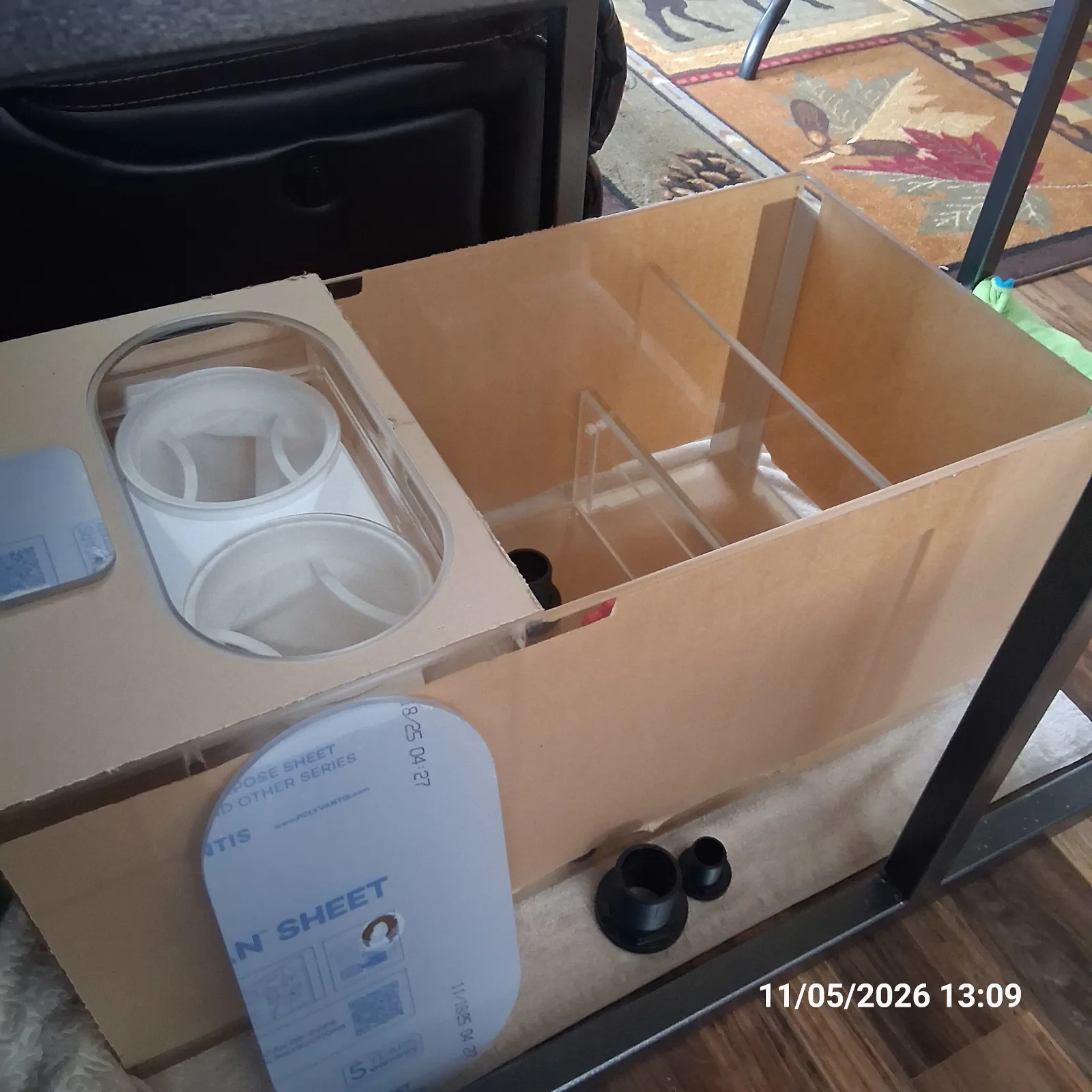
It’s time to plan the part that most influences a reef tank’s long-term success: the plumbing, and the maintenance it will demand of me (a topic for its own entry).
- Is hauling buckets for water changes sustainable for the life of the tank?
- If there’s space in the basement next to the utilities — drains, fresh water, and electricity — should all life support systems live there instead of under the tank?
- What does it cost to run larger, higher-head-pressure pumps 24 hours a day, year after year?
- Will I want a frag tank for corals trimmed during fragging? Plumbing one into the main system now would make the future easier, since there’s still only one water column to test and monitor.
- Once you have a wall to work with instead of the inside of a stand, doesn’t mounting and plumbing all of it become trivial?
The full equipment list that has to fit in a confined space is overwhelming — and in practice it spills into the living area anyway. Success at growing coral also adds sprawl beyond what this list covers: calcium reactors, biopellet reactors, refugiums, kalkwasser, and other filtration or dosing gear a reef can need as it matures over the years.
Heating and cooling
- Heaters — critical here in northern Wisconsin.
- Chiller — the basement should eliminate the need for one.
Filtration
- Filter socks — trap detritus and particulate matter before it reaches the rest of the system. Why not a filter roller? A roller is essentially a subscription: you keep buying fleece. Socks get tossed in the washing machine with a little bleach — no detergent, extra rinse — and can last years.
- Protein skimmer — removes organic compounds such as proteins and lipids by binding them to air bubbles and collecting the resulting foam.
- Ultraviolet (UV) sterilizer(s) — sterilizes free-floating algae, bacteria, and parasites in the water column, which means less scraping of the viewing panes. That matters with acrylic, which scratches easily: the less you touch it, the better.
- Carbon filtration — removes dissolved organic compounds, pigments, and medications that enter the water through normal household life.
- Granular ferric oxide (GFO) reactor — binds phosphate (PO₄) that builds up from feeding fish so it can be removed from the water.
- CO₂ scrubber — a canister of soda lime on the skimmer’s air intake that strips indoor CO₂ before it dissolves into the water, where it would lower pH and slow coral growth.
Dosing and evaporation top-off
- Dosing pump(s) — replenish the elements corals consume as they grow: alkalinity, calcium, and magnesium. One part can cover all three, which is why I run All For Reef; extra heads are for trace elements, coral food, or a spare.
- Dosing fluid containers — the fluids have to live somewhere. I reuse old carbon containers: drill a hole in the lid and push 1/4-inch rigid acrylic tubing through it.
- Auto top-off (ATO) system — water evaporates continuously but the salts don’t, so the lost water has to be replaced with reverse osmosis/deionized (RODI) water.
- ATO reservoir — holds that fresh water, ideally sized for a week or two of evaporation.
Mechanical and flow
- Return pump(s) — move water from the sump back up to the tank, no small feat with the sump in a basement halfway across the house.1
- External Herbie overflow — two 1.5-inch drains in a small box mounted outside the tank. The primary drain carries a gate valve so I can dial the flow back until the siphon runs silent; the second sits dry, its open end a little higher, as an emergency if the primary plugs — and it will make noise if it ever starts carrying water, which is the point. Because the box hangs off the tank wall, every bulkhead through that wall is a leak point: one more reason the basement beats a living-room stand.
- Powerhead and flow controllers — corals thrive in random, turbulent flow.
- Piping and tubing — uniting all the moving parts takes more infrastructure than it looks.
- Electrical wiring — enough circuits for 14–18 life-support outlets and another 8–12 for the lighting. Everything above needs power, so planning that wiring and making it safe is a priority.
⚠️Safety: Always use GFCIs and drip loops, and never plug anything in at floor level under or around the tank. Saltwater and electricity are a fatal combination for humans and livestock alike. Read up on saltwater aquariums and electricity before you power anything up — I can’t cover those hazards in detail here.
Controls and monitoring
- Backup batteries — keep water moving during an outage until the generator starts; stagnant water loses oxygen fast enough to kill livestock.
- Temperature controllers — hold the tank at 75–78 °F, which I believe is what corals prefer (they have never complained).
- pH probe and monitor — a sustained pH below 8.0 suggests the CO₂ scrubber media is spent or the house needs the windows opened.
- Water leak detectors — to alert us to a leak, or a burst line, before it becomes a flood below living level.
We have made the decision to plumb everything into the basement, next to the RODI unit and the saltwater mixing station. My workbench for water testing, the chemicals (All For Reef by Tropic Marin, which replenishes alkalinity, calcium, magnesium, and the trace elements corals consume), the filter media changes, and the utility sink are all within arm’s reach. Water tests, weekly water changes, and equipment maintenance all get simpler — who wants to carry a stinky skimmer cup through the house when you can rinse it in the sink next to the sump?
Roughly 1 ft of vertical head ≈ 0.43 psi, and every 90° elbow adds a bit more. More vertical head means more watts to move the same water. ↩︎